ETV Canada independently verifies the performance claims of innovative environmental technologies, giving purchasers, regulators and developers a credible basis for decision-making.
Explore ETV and ISO 14034 through these resources from CSA Group. Download the full PDFs for easier reading, save them for later or share them with your team.
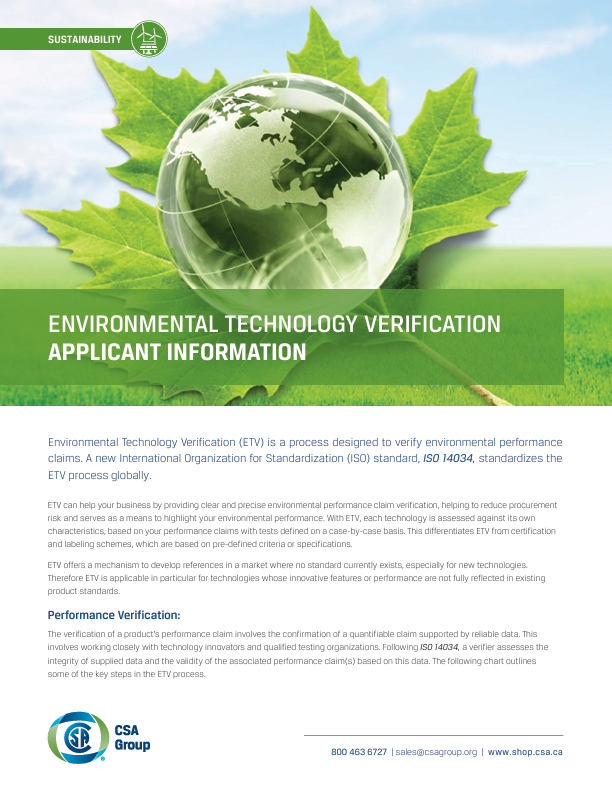
Learn which technologies are eligible, what supporting data you’ll need and how the process works, from initial application to final verification.
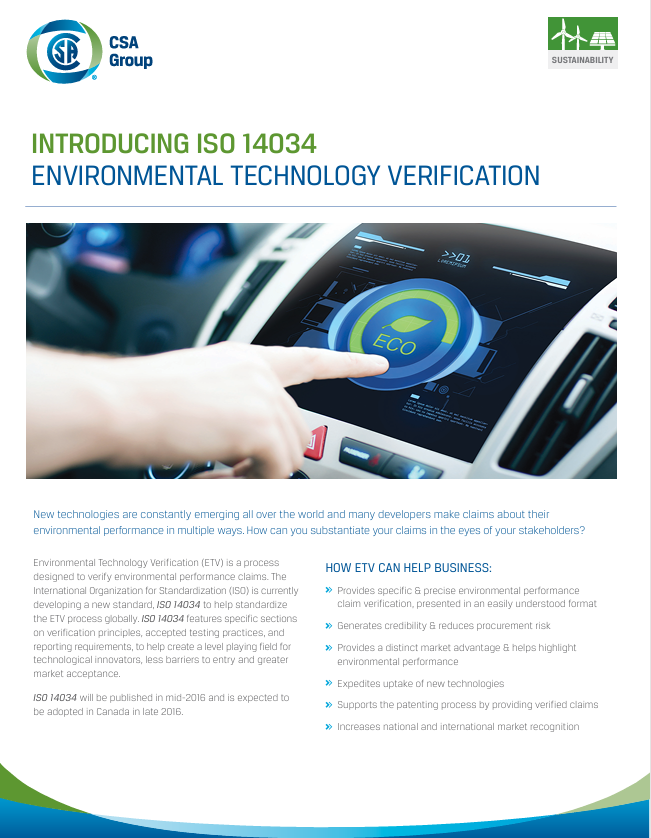
Learn how ETV can help your business demonstrate technology performance and build buyer confidence, with an overview of the main stages of verification.
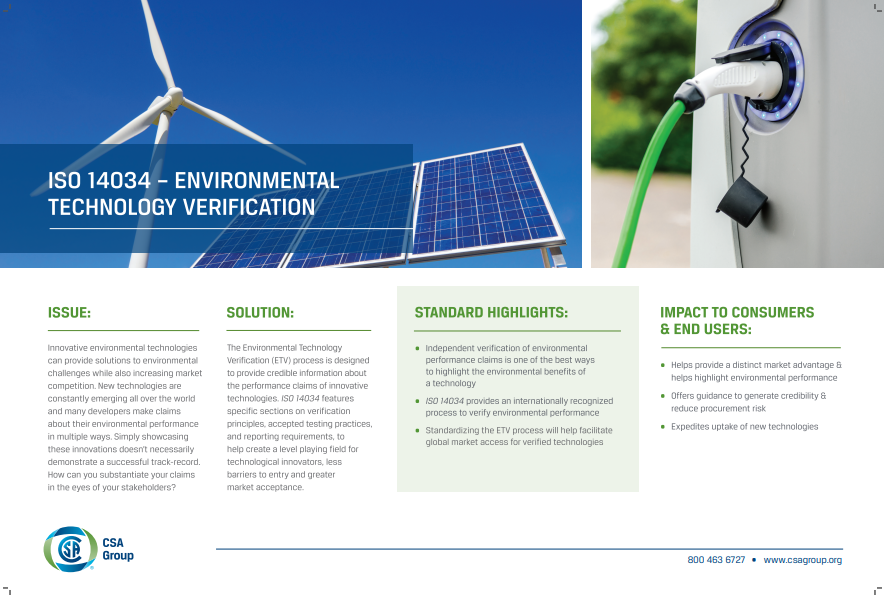
Explore the key features of ISO 14034 and how independent verification helps developers demonstrate performance and buyers assess new technologies.
Verification checks whether a technology performs as claimed. With ETV, the assessment and testing are tailored to the technology and its specific performance claims.
Certification and labelling schemes assess whether a product meets predefined criteria or specifications.
ETV is particularly useful for new technologies where no relevant product standard exists, or where existing standards do not fully account for the technology’s features or performance.
ETV can apply to technologies that prevent or manage pollution, improve energy and resource efficiency, or reduce the environmental impact of goods and services. Examples include:
These examples are not exhaustive; other environmental technologies may also be eligible.
Applicants are responsible for arranging testing of their technology. ETV reviews the resulting data to verify performance claims. The verifier can provide guidance on the testing needed to meet ETV requirements.
Yes. You can submit existing test data that supports your performance claim, including data collected before and after technology installation or operation. To be accepted:
If you do not have suitable data, the verifier can suggest testing organizations or accredited laboratories during the screening stage.
The applicant owns the final verification report. The verifier keeps a copy for its records and will not release or share it without the applicant’s written permission.
The verifier only makes the Technology Fact Sheet, also called the Verification Statement, publicly available.
Additional conditions may apply.
Applicants are generally responsible for testing costs. However, municipal, provincial or federal programs may offer funding for research and development projects that include testing. Eligibility and available support vary by program.
Test data more than five years old is unlikely to be accepted for verification.